+86-15857000395
Industry News
Home / News / Industry News / How to Import Interior Doors from China: A Practical Guide for First-Time Buyers

How to Import Interior Doors from China: A Practical Guide for First-Time Buyers

2026-11-13

Sourcing interior doors from China is a cost-effective decision a distributor, contractor, or apartment developer can consider. Chinese factories can produce PVC MDF doors, veneer painted doors, and solid wood doors at substantial production volumes — one mid-size factory in Zhejiang can ship 20,000 door sets per month on its own.

But a door is also a bulky, fragile, specification-heavy product. Buyers who skip the preparation steps usually run into the same problems: wrong sizes, damaged finishes, unclear pricing, or containers that hold fewer doors than expected.

This guide walks through the full process — specification, supplier verification, quotation, samples, pricing terms, quality control, and shipping — based on what actually happens inside a Chinese door factory every day.

A 30,000㎡ door manufacturing facility in Jiangshan, Zhejiang

Step 1: Lock Down Your Specification Before You Ask for a Price

Many sourcing problems start with an incomplete specification. If you send a factory an inquiry that says "interior door, PVC, white color, 200 pieces," you will get a quote you cannot compare and a product you cannot sign off.

Before requesting a quotation, put these details in writing:

  • Door leaf thickness — 35 mm, 40 mm, or 45 mm. 40 mm is a commonly used thickness for interior doors.
  • Panel material and thickness — MDF panels commonly come in 5 mm, 6 mm, or 8 mm.
  • Core filling — honeycomb paper, MDF strips, tubular chipboard, or finger-jointed solid wood strips. This is a major factor affecting price, weight, and sound performance.
  • Surface finish — PVC film (0.12–0.18 mm thickness), melamine, veneer, or paint. Film thickness matters: the choice of film thickness can affect handling and installation durability.
  • Frame structure — PVC-wrapped MDF frame or solid wood frame, and the wall thickness it needs to fit (120 mm, 150 mm, 200 mm are common).
  • Sizes — confirm standard size (2000 × 800 × 40 mm is typical) and whether your project needs custom heights up to 2350 mm.
  • Hardware — hinges (usually 3 per door), lock types, door stoppers, and whether they are included or supplied separately.

For reference, a full specification table for PVC MDF doors — including film thickness, filling options, frame details, and customization ranges — is available on our PVC MDF Door product page. 
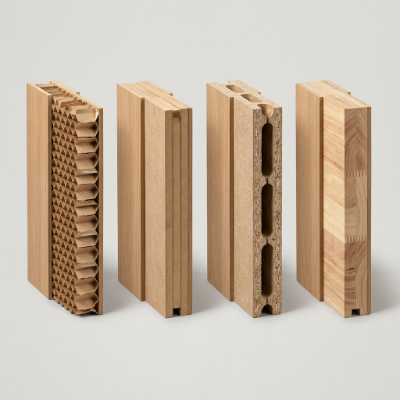
Four core filling options — honeycomb paper, MDF strips, tubular chipboard, finger-jointed solid wood

Step 2: Verify You Are Dealing with a Real Factory

China has both real manufacturers and trading companies that resell. Neither is automatically wrong — trading companies can be useful for mixed-container orders — but you should know which one you are talking to, because it affects price, lead time, and accountability.

Three quick verification steps:
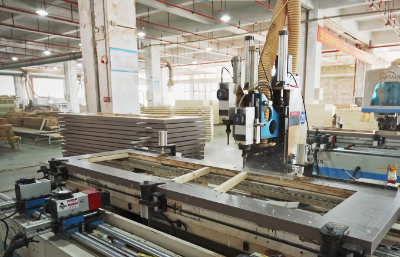
  • Check the business license scope. A manufacturer's license shows "manufacturing" as the business scope and lists the registered address in an industrial zone. You can verify this through a third-party supplier-verification service or during a video call.
  • Ask for a live video walkthrough. Request an unscripted video call from the production line, not a pre-edited marketing video. Ask them to show you the laminating press, the frame assembly area, and the packaging line in one continuous shot.
  • Check whether production capacity matches the factory setup. Ask about the production equipment, workshop layout, workforce, production shifts, and the types of doors being manufactured. You can also request recent production records or photos of active production lines. Compare this information with your expected order volume and delivery schedule rather than relying on machine counts or factory size alone.

Laminating production line

Step 3: Request a Quote That Can Actually Be Compared

  • Door leaf unit price
  • Frame (and architrave) price per set
  • Hardware cost, if included
  • Packing method (flat-pack carton vs. fully assembled) and packing cost
  • Minimum order quantity (MOQ) and production lead time

Typical MOQs in this industry range from 50 to 200 sets per design or color. Lead times run 25–40 days after deposit and after sample approval — anything quoted below 20 days for a full container deserves scrutiny.

A useful benchmark for your budget: for a standard 40 mm PVC MDF interior door set, FOB China prices generally land in the range of typically falls in a mid-range band depending on specification per set depending on filling material, film thickness, and frame type. Quotes far below this range usually mean 0.12 mm film, honeycomb-only filling, and reduced frame material — all of which show up later as warranty claims.

Step 4: Order Samples — and Know What to Check

Never skip samples, and never approve a sample without testing these five things:
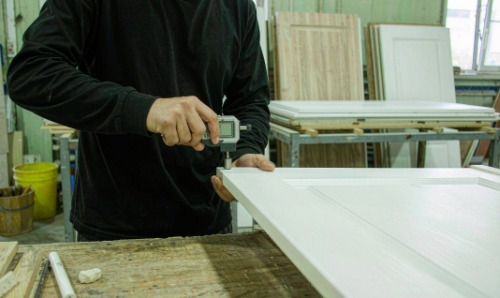
  • Film adhesion and edge banding. Run your fingernail along the PVC edge banding on all four sides. Poor edge banding is a common source of customer complaints in humid climates.
  • Flatness. Lay the leaf on a flat floor. Check for twist across the diagonal; a twist of more than 2 mm over a 2000 mm leaf will show up on installation.
  • Weight. Weigh the leaf. Compare it with the filling you specified — honeycomb-filled leaves are lighter than tubular chipboard ones, and the scale does not lie.
  • Frame joints. Check the 45° miter joints on the frame and architrave. Gaps here telegraph badly on finished walls.
  • Finish consistency. Compare the sample color against your color card reference under daylight, not just indoor lighting.

Verifying film thickness and leaf flatness on an approved sample

Step 5: Understand FOB, CIF, and How Many Doors Fit in a Container

Many door disputes at this stage come from two misunderstandings: who pays for what, and how much actually fits in the box.

Incoterms, in plain language:

  • FOB (Free on Board): the factory delivers the goods cleared onto the vessel at the Chinese port. You pay ocean freight, insurance, and destination charges. This is a commonly used term for experienced importers.
  • CIF (Cost, Insurance and Freight): the factory pays freight and insurance to your port. Easier for new buyers, but you lose some control over the shipping line and rates may include a service margin.

Container loading — plan with real numbers, not guesses.

A 40 ft high cube container has roughly 67–68 cbm of usable volume. With flat-pack packing, a standard 2000 × 800 × 40 mm door set (leaf + frame + architrave + hardware carton) occupies approximately 0.14–0.16 cbm packed. As a working estimate:

Container Typical loading, PVC MDF door sets (flat-pack)
20 ft GP 300–350 sets
40 ft GP 600–650 sets
40 ft HQ 700–800 sets

Solid wood doors and fully pre-hung assemblies load significantly fewer sets — ask the factory for a loading plan before you promise quantities to your own customers.

Step 6: Put Quality Control in Writing Before Production Starts

Your purchase contract should state, at minimum:

  • Approved sample number (or sealed sample kept at the factory and a duplicate with you)
  • Film thickness, filling material, and leaf weight tolerance (e.g., ±0.5 kg per leaf)
  • Color tolerance against the confirmed color card
  • Packing standard: carton material, corner protection, moisture barrier, pallet or no pallet
  • AQL or inspection standard for the pre-shipment inspection, and who performs it

For an initial order, hire a third-party inspection company (typically USD 150–300 per man-day) to run a pre-shipment inspection against your spec. A factory that supports independent inspection should be able to accommodate this request. A factory that resists an independent inspection is telling you something.
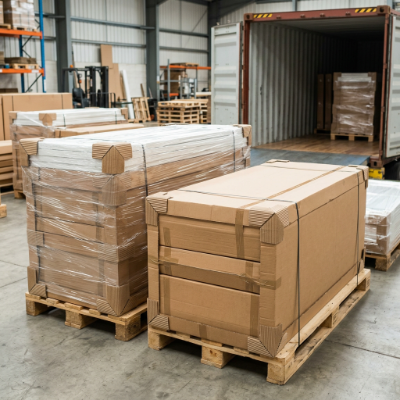
Export packing — corner protection, moisture barrier, and palletized stacking

Step 7: Documents and Customs Clearance

For many destinations, a Chinese door factory will provide:

  • Commercial invoice
  • Packing list
  • Bill of lading (B/L)
  • Certificate of origin (CO / Form if applicable)

Depending on the destination market you may also need: fumigation certificate (for solid wood components or wooden pallets), CE documentation for certain European applications, or SONCAP, SABS, SASO-type conformity documents for specific countries. Confirm the document list with your customs broker before production starts — retrofitting documents after the vessel sails is expensive and sometimes impossible.

Step 8: Receive, Inspect, and Store Correctly

Wood-composite doors keep moving even after they arrive:

  • Unload and inspect within 2–3 days against the packing list; photograph any damage before signing off with the carrier.
  • Store doors flat, indoors, with humidity between roughly 40% and 70%. Never stand unwrapped leaves against a wet wall.
  • Let doors acclimate to the installation environment for 48–72 hours before hanging, especially where the site is air-conditioned or freshly plastered.
  • Install only after paint and wet work on walls is complete — moisture from fresh plaster is a common cause of post-installation warping complaints.

Five Mistakes New Door Importers Make

  1. Choosing the cheapest film thickness. A 0.12 mm film can save USD 0.5 per door and cost you a container of peeling complaints.
  2. Confirming color by email description. "White" is not a specification. Use a color card number, or a physical sample, every time.
  3. Ignoring frame wall-thickness compatibility. A frame built for 120 mm walls will not fit a 200 mm wall. Send the wall thickness with every order.
  4. Ordering assembled pre-hung doors into an initial container to "save installation time," then discovering the container loads 40% fewer sets than planned.
  5. Skipping the pre-shipment inspection on an initial order — the exact order where you know the least about the factory.

Frequently Asked Questions

What is the typical MOQ for importing interior doors from China?

Many factories set 50–200 sets per design or color, with a minimum of one mixed container for export pricing. Custom colors often carry a higher MOQ because film and paint batches have setup costs.

How long does the whole process take?

For a standard container: 7–10 days for samples, 25–40 days for production after sample approval, and 15–35 days of ocean freight depending on destination. Plan 2–3 months from initial inquiry to goods on site.

How do I verify the door quality before shipping?

Combine three things: an approved sealed sample, defined tolerances in the contract, and a pre-shipment inspection — either your own inspection agency or a third-party inspection service.

Can I order custom sizes and colors?

Yes. Reputable factories can produce door leaves up to about 2350 × 1100 mm, custom film colors from a 200-color card, and frames matched to wall thicknesses of 120 mm, 150 mm, and 200 mm.

PVC MDF, WPC, or solid wood — which should I import?

PVC MDF doors are used in volume projects (apartments, hotels) based on cost and consistency. WPC is commonly considered for high-humidity markets. Solid wood suits residential projects where natural wood construction is preferred. Importers may consider PVC MDF for a broad customer base.

Who handles shipping and customs?

Under FOB terms, you or your freight forwarder handles ocean freight and customs. New importers often start with CIF and let the factory arrange freight to the destination port, then clear customs through a local broker.

Working with a Factory Directly

If you are planning an initial or subsequent container of interior doors, it helps to talk directly with a manufacturer that controls its own production. SUPERU (Zhejiang Shangpin Bense Home Furnishing Co., Ltd.) has produced PVC MDF, veneer painted, melamine, WPC, and solid wood interior doors in Jiangshan, Zhejiang since 2016 — 30,000 square meters of workshop, more than 200 production staff, and a monthly capacity of 20,000 sets, with OEM and ODM service for overseas brands.

Send us your specification sheet or project drawing, and we will return a line-item quotation, a loading plan, and a sample proposal within one working day. Contact us here.

Zhejiang Shangpin Bense Home Furnishing Co., Ltd.
Zhejiang Shangpin Bense Home Furnishing Co., Ltd. was established in 2016 and is located in Jiangshan City, Zhejiang Province. It is a large-scale professional door manufacturer engaged in the research and development, production, sales and service of interior door products. Our door brand is "SUPERU". We also accept ODM and OEM orders.