

2026-11-17
Every door factory knows the phone call. A family finished a renovation, everything looked fresh, and three months later the bathroom door would not close without a shove. The frame had not moved. The house had not moved. The door had swollen, quietly, because steam from daily showers found the one surface in the room that was never chosen to handle it.
Enquiries for moisture resistant interior doors have climbed noticeably this year across export markets, and the reason is not fashion. Homeowners have started treating wet rooms as a materials problem rather than a decoration problem, and that change in thinking is reshaping what distributors stock and what renovation firms specify.
Content
A bedroom lives in dry air. A bathroom does not. Every hot shower fills the room with vapour, the vapour condenses on cool surfaces, and the door leaf sits right in the path of it. Overnight the surface dries, but the moisture that crept into the edges stays there, and the cycle repeats the next morning.
Wood and standard fibreboard react to that cycle by swelling at the edges, where finishes are thin and cut-outs for hinges and locks leave bare material exposed. The leaf goes out of square, gaps close up, and a door that swung freely in winter drags along the frame in summer. Paint slows the process. It rarely stops it.
Usage patterns have made the problem worse. Showers run hotter and longer than a generation ago, extractor fans are absent in a large share of apartments in many markets, and families close the bathroom door during and after every shower, trapping damp air against the leaf itself.
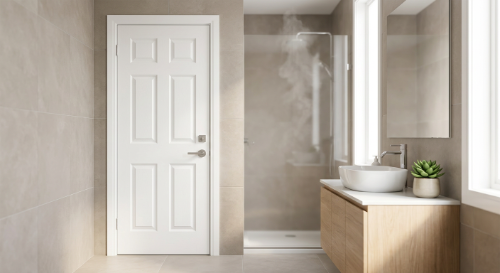
The phrase has become a selling point, and like many selling points it covers a range of constructions. Three questions separate a genuinely protected door from a label.
A supplier who answers those questions with construction details is selling protection. A supplier who repeats the phrase without details is selling words.
| Construction | Behaviour in a humid room | Where it fits |
|---|---|---|
| Solid wood leaf | Moves with humidity; edges swell; needs periodic resealing | Dry bedrooms, studies and living rooms |
| Painted fibreboard | Surface holds up at the beginning; unsealed edges absorb steam over time | Dry or only slightly humid interiors |
| PVC faced composite | Skin sheds water and steam; stability depends on sealed edges and core | Kitchens and busy family bathrooms |
| WPC through the body | The material itself does not absorb water | Bathrooms, laundry rooms, coastal apartments |
The bathroom is the obvious candidate and rarely the only one. A walk through an ordinary home turns up more wet-zone doors than buyers expect.
Specifying by room instead of by budget line changes the conversation. The bedroom doors can stay wooden for warmth. The wet-zone doors can move to materials that ignore the weather inside the room.
You can, and it takes less time than unpacking a sample. The table below lists the checks our export team recommends to distributors and renovation firms before they commit to a container.
| Check | What a well-made door shows |
|---|---|
| Edge banding | Continuous banding with no open joints at the corners |
| Bottom edge | Sealed like every other edge, not left bare because nobody sees it |
| Hardware cut-outs | Machined and sealed in the factory, with clean recesses |
| Surface bonding | Skin pressed tight with no lifts at the corners or around profiles |
| Weight and feel | Consistent density, no hollow drum sound on large flat areas |
| Sample soak test | Cut a sample edge and leave it in water; honest constructions separate quickly from weak ones |
That soak test sounds crude and remains one of the honest shortcuts in the trade. A core that survives a night in a cup of water will shrug off years of bathroom steam.
At the moment of purchase, a protected door usually carries a higher price than a basic painted one. The gap narrows once maintenance enters the calculation. A wooden door in a humid room asks for resealing, repainting and occasional adjustment of the frame as the leaf moves. A moisture resistant leaf asks for a wipe with a damp cloth and little else.
For a family, the difference shows up as fewer annoying repairs. For a landlord or a hotel operator, it shows up as rooms that stay rentable instead of waiting on a carpenter. Multiply one sticky door across fifty rooms and the arithmetic becomes obvious without any spreadsheet.
The other cost people forget is replacement. Once a fibreboard leaf swells, no amount of sanding brings it back. The door comes off, a new one goes on, and the original saving disappears twice over.
Regional climate shapes the enquiry list as much as fashion does, and the differences are worth knowing before a specification is written.
Across all four regions the direction is the same: the wet-zone door has become a separate purchasing decision with its own requirements, its own checks and its own vocabulary.
Can a moisture resistant door still look like wood?
Yes. Modern film and lamination transfers reproduce grain convincingly, so wet-zone doors no longer announce themselves as plastic.
Do these doors suit bedrooms as well?
They can, though dry rooms do not demand the protection. Many buyers keep wood in bedrooms for warmth and reserve protected constructions for wet zones.
How long should such a door last in a busy bathroom?
Long enough that the bathroom is renovated before the door is. Lifespan depends on construction quality, which is why the checks above matter more than the label on the quotation.
Is WPC the same as PVC faced board?
No. WPC carries its protection through the whole body of the material, while a PVC facing protects the surface and depends on sealed edges underneath. Both work; they fail differently when they are made badly.
What information should I give a factory when ordering?
Room type, humidity conditions, finish preference and hardware. A factory that asks those questions is a factory that has shipped containers of doors that stayed flat.
Many schedules start with surfaces and finish with doors, which is exactly why doors end up chosen in a hurry. Reversing one step costs nothing: decide the wet-zone doors early, alongside the tiles. The rooms that mist up every morning are the ones that punish a late, rushed decision, and they are also the rooms guests remember. Choosing moisture resistant interior doors there, while the budget is still being planned rather than after it has been spent, turns the least glamorous part of a renovation into the part that still works ten years later.
Copyright © Zhejiang Shangpin Bense Home Furnishing Co., Ltd.

Wood Interior Door Manufacturer
 русский
 عربى
 Français
 Español