

2026-11-20
Twice a year, in the wet season and again when summer humidity peaks, maintenance teams across humid regions brace for the same wave of complaints. Doors that closed smoothly in the dry months start to bind at the frame. Surfaces bubble at the edges. Users blame the hinges, the installers blame the frame, and nobody blames the moisture that caused the whole episode.
For door suppliers serving coastal cities, monsoon regions and tropical markets, this seasonal pattern is not news. What is new is how quickly buyers have started asking about it before they order, and how prominently moisture resistant interior doors now sit in project specifications that once mentioned only style and price.
Content
Doors live in the air of the building. When the air holds more water, porous materials hold more water too. A leaf made from wood or unsealed fibreboard gains weight, swells across its width, and presses against a frame that was set to a small clearance in a drier month.
The swelling is rarely uniform. Edges absorb moisture faster than faces, cut-outs soak faster than flat skin, and the leaf distorts rather than simply growing. That distortion explains the familiar symptoms: a door that rubs at one corner only, a latch that no longer meets the strike plate, a gap that looks even in winter and disappears in summer.
Nothing in that process is sudden, which is why it fools people. The damage accumulates through hundreds of humid days, and by the time the door sticks, the material has already changed shape for good.
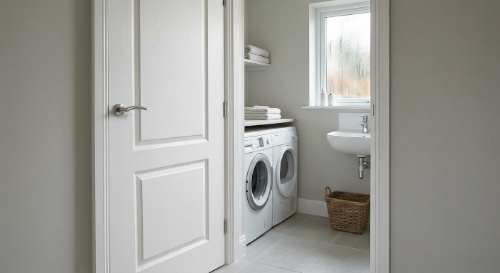
Humidity damage announces itself early if someone is watching. These signals tend to appear in the same order, season after season.
Facility teams that log these signals can plan replacements on their own schedule. Teams that wait bind themselves to the weather instead.
Materials differ enormously in how they respond to airborne water, and the differences decide the whole ownership experience in humid regions.
| Construction | Response to humid air | Maintenance pattern in wet seasons |
|---|---|---|
| Solid wood | Absorbs and releases moisture; swells and shrinks with the seasons | Adjustment, resealing, watching every change of season |
| Unsealed fibreboard | Swells at exposed edges and rarely returns to shape | Early edge damage, progressive distortion |
| Sealed composite with film or melamine skin | Skin blocks vapour; sealed edges keep water out of the core | Routine cleaning only |
| WPC and similar full-body composites | Material barely reacts to humidity at all | Routine cleaning, no seasonal cycle |
The table explains a pattern our export team sees every year: enquiries from Southeast Asia, the Gulf and coastal Africa increasingly specify full-body or fully sealed constructions for anything behind a bathroom or kitchen door, while drier inland markets still order freely across the range.
Buyers who have lived through one swollen season ask sharper questions than buyers who have not. The list below collects the checks that matter, including two that concern the journey rather than the product.
| Point to confirm | Why it matters |
|---|---|
| Core material and edge sealing, described in writing | The label moisture resistant means little without construction details behind it |
| Hardware cut-outs sealed at the factory | Lock and hinge recesses are the common entry points for water |
| Packaging with moisture protection | Sea freight exposes doors to weeks of humid, shifting air inside a container |
| Container loading with airflow and desiccants | Container sweat has ruined more doors in transit than any bathroom ever will |
| Sample tested in real site conditions | A door that performs in a showroom still has to earn its keep in a steamy corridor |
That second pair of rows surprises buyers who assume the factory gate ends the risk. A container crossing the equator cycles through heat and condensation daily. Wrapping, desiccants and sensible stacking are part of delivering a moisture resistant door that is still flat when the truck arrives.
In a private home, one sticky door is a nuisance. Across a hotel floor or a rental portfolio, it is a maintenance category with its own budget line. Housekeeping staff douse surfaces with water daily, guests shower at all hours, and corridors hold the damp air that bathrooms push into them.
Operators who switch wet areas to moisture resistant interior doors report the change in their maintenance logs rather than in brochures: fewer carpenter call-outs, fewer emergency replacements between guests, and rooms that return to service on schedule. The doors cost more on the purchase order and less every quarter after that.
Public buildings add a further argument. A school or clinic cannot close a toilet for two days because a leaf warped. Availability, not appearance, drives the specification, and stable constructions deliver availability.
A protected leaf installed into a badly detailed opening still collects water, which is why experienced buyers treat the frame, the threshold and the room finish as part of the same specification. Three details carry a surprising share of the outcome.
None of these items appears on a door quotation, and all of them decide whether the protection built into the leaf gets a chance to work.
Is humidity a problem only in tropical markets?
No. Any building that showers, cooks or dries laundry indoors generates its own humidity, and temperate coastal cities run damp for a large part of the year. The climate outside matters less than the water used inside.
Can wooden doors survive in humid regions at all?
Yes, with dense species, factory sealing and a maintenance routine that the owner actually follows. The question is whether that routine will really happen, and in busy buildings it usually does not.
How should doors be stored on site before installation?
Flat, wrapped, off the floor and away from open windows. A door that leans against a damp wall for a month has begun its career with a head start on distortion.
Does air conditioning remove the need for protected doors?
It reduces the hours of high humidity, but doors near bathrooms and kitchens still see daily spikes, and systems get switched off. Protection at the door remains cheaper than controlling the whole building.
What is the honest limit of a moisture resistant door?
Standing water and soaked frames defeat any leaf. Protecting the door includes detailing the floor and frame so water drains away rather than pooling against the bottom edge.
The seasonal door call comes every year, and every year it was preventable with a decision made months earlier at the ordering stage. Buyers who specify moisture resistant interior doors for wet zones, confirm edge sealing in writing and insist on protected packing are not spending more; they are moving the same money from repairs to the product. If your next project runs into a humid season, ask your supplier one question before signing: how will these doors look in July? A factory with a straight answer is a factory worth a container.
Copyright © Zhejiang Shangpin Bense Home Furnishing Co., Ltd.

Wood Interior Door Manufacturer
 русский
 عربى
 Français
 Español